Is That All For Me? Pan Pacific High Tea for a High Roller Kid

The writer and his apprentice were guests of Pan Pacific Perth.  The article was provided to Pan Pacific Perth.

OLYMPUS DIGITAL CAMERA
Three tiers, so little time

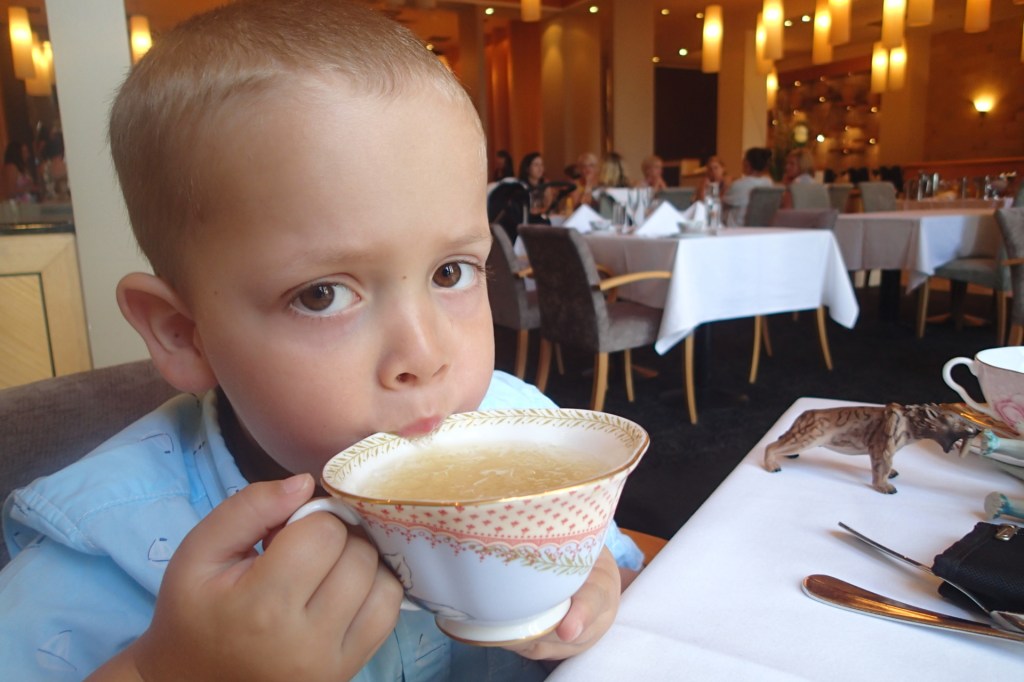
Tom’s first comment was, “Is that all for me?”

I watched Tom. I love watching him do anything at all and this was no different. He was focused on the tiers in front of him, fully occupied with his own delicate tea cup of sweet, fresh apple juice and his hand reaching out for his food like one of those old money boxes I had as a kid where the hand shoots out, grabs a coin and then withdraws back with its booty.

Tom started on the first tier which held a peanut butter man, nutella soldier, brioche with shredded honey ham and lettuce and two freshly made corn chips with boccincini and tomato.  Five minutes later they were gone.

The second tier required one hand to push down on the chair as he reached up with the other hand for rocky road, pandan and vanilla crème, profiterole with festive icing and a chocolate fudge with its own little hat; a strawberry macaroon.

OLYMPUS DIGITAL CAMERA
Tom meets his first Executive Chef

By this stage he was beginning to forget the journey and just wanted the finish line.  Desperate to commence the final ascent he asked if he could forego finishing each of the second tier treats and launch himself at the summit.

Positioning himself on his knees, resting his tummy on the lip of the table, he leaned in and reached for glory.

Atop the final tier was a gingerbread house with resident gingerbread man and snowman, Olaf in fact.  The house was in need of a good decluttering though.  Every room in the house was completely packed with chunky rocky road, adding substantial weight to this sweet dwelling.

With assistance from Leah to lower it to the table, Tom looked at me and said, “Epic!”

OLYMPUS DIGITAL CAMERA
Leah and Tom tackle Olaf

I asked Tom why he said that. What made him use the one word that I know from his vocabulary and character is saved for only the best of times and the best of experiences?

“It’s yummy and fun.”  Perfect.

The West Australian newspaper: Abrolhos for the Echoes of the Past

OLYMPUS DIGITAL CAMERA
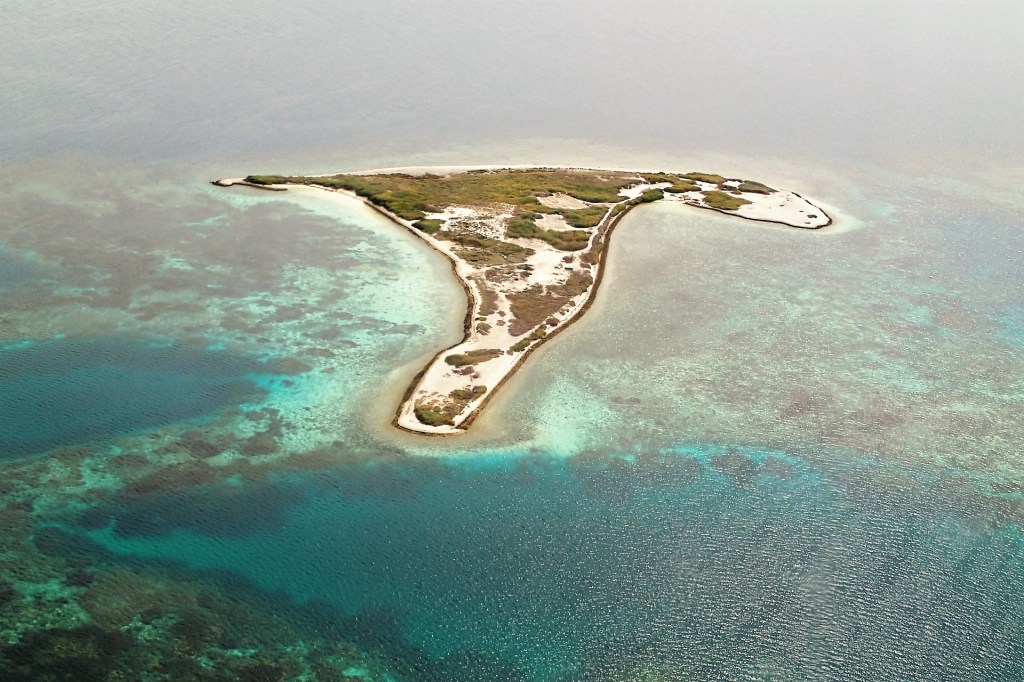
One of the islands currently under archeological exploration for Batavia shipwreck victims

Originally published by the West Australian newspaper

Before driving to Geraldton to meet a charter flight to the Abrolhos Islands I did a quick internet search on the drive from Perth. Just checking the distance and potential stops along the way to have a stretch.

In 1629, a good sailor had the remarkable ability to calculate latitude but not longitude. So sailors who could navigate were, at best, capable of working out how far up or down they were but had to guess how far across they were based on the estimated speed of their vessel.

It’s for this reason that so many ships from centuries past slammed into our coast as they flicked under the Cape of Good Hope and belted across the Indian Ocean on the Roaring 40’s and made a guess when to turn north for the Dutch East Indies.

And there I was, calling up in a matter of seconds on the internet a route map for my north bound destination.

In 1628, preparations for a greater voyage than mine in 2015 were well underway.

The Batavia had just been built. It was the most magnificent ship that the VOC, the Dutch East India Company, had ever built. It promised its owners years of delivering valuable cargo and satiating European appetites for spices, bringing with it enormous profits for an already wealthy and powerful shipping company.

My preparations for this trip had largely been based on rereading one of Western Australia’s great books, Islands of Angry Ghosts by Hugh Edwards. First published in 1966, my copy got wet at the beach many years ago and has an odd look and smell to it but that’s become part of its appeal.

I am reacquainting myself with the story of the Batavia; how it became shipwrecked off the Western Australian coast and the unfolding drama of 386 years ago which saw villains and heroes fight out a remarkable battle for survival that left over 120 men, women and children brutally murdered.

Geraldton is 424km north of Perth and is the heart of the Mid West Region. Driving with a few rest breaks in quiet seaside towns like Leeman, Jurien Bay and Dongara will get you there in about five hours or you can fly up and miss all the scenery and be there in an hour. The shared fascination my daughter Matilda and I have for the story of the Batavia and the curiosity to see the Abrolhos Islands where it all happened is why we’re sharing this adventure.

Our flight with Geraldton Air Charters is one of several available that operate from Geraldton Airport. While there are also plenty of boat charters that make the 70km journey out to the islands we had some time constraints that have us choose an option that gets us in and out in a day.

The Chief Pilot, Wendy Mann, has a busy weekend ahead of her. As well as our flight there is a local band to fly out for a party on one of the seasonally occupied islands. Easter is one of the busiest weekends on the Abrolhos and the flight out just needs to follow the long white wakes of the numerous boats making their way out to the islands from Geraldton.

Our first look at the islands are those in the Pelsaert Group, wrongly named after Commander Pelsaert of the Batavia in the belief that the ship sunk in this group of islands.

This is the most southern group of islands and we fly over numerous wreck sites including the Zeewjik, Ocean Queen, Windsor and Ben Ledi.

Further to the north is the middle group of islands in the Abrolhos, the Easter Group. Of the 122 islands in the Abrolhos around 20 have established camps for the fishing community and nearly all of these are in the Easter Group. Jetties protrude over the coral from these islands that are dotted with colourful huts that are home for fishers and their families through the crayfishing season of March to June.

We fly on and soon reach the Wallabi Group and our pilot skilfully tips the wing so that it is just above sight of Wiebbe Hayes’ stone fort on West Wallabi Island.

After Pelsaert and a number of his crew sailed the longboat to Batavia to seek help, the highest ranking official in charge was Jeronimous Cornelisz whose leadership style was keen on mutiny and piracy. He scattered the survivors to various islands under the pretence of searching for food and water.

Hayes and his soldiers found plentiful water and food on the island and constructed the fort with flat rocks as protection from the wind and later as a defence from repeated attacks by well-armed mutineers led by Cornelisz, who they managed to capture shortly before the return of Pelsaert in the rescue ship Sardam.

Wiebbe Hayes was promoted on the spot by Pelsaert and later became an officer. There is nothing else we know about this remarkable young man who designed and constructed the first European structures in Australia.

We land on East Wallabi Island, where Wiebbe Hayes and his men first landed before crossing the shallow water to West Wallabi Island. The gravel airstrip, one of three throughout the islands, was built during World War II by the RAAF and the occasional flight of Avro Ansons was stationed there with staff from the Flying Training School based at Geraldton. We walk from the aircraft to Turtle Bay, a beautiful curved stretch of white sand, strewn with an assortment of shells.

Snorkelling in Turtle Bay is amongst the best you will find in Western Australia. Over 200 coral species have been identified in the Abrolhos and I think I saw all of them. The vivid colours of the coral stay fixed as hundreds of differently coloured fish mix the palette by swimming across your view and trepang loll back and forth to the rhythm of the sea. We give our favourite coral the scientific name of Ladies Hanky; it is bright purple and looks like it has been gently draped on the reef.

We explore the shoreline, filled with stubborn oysters, grumpy crabs and a feeling of discovery around each craggy bend. Walking around the island reveals massive osprey nests and skinks with black and gold speckled scales. Elusive from our view are the tammar wallabies that on West Wallabi Island were such a valuable food source to Wiebbe Hayes and his men.

In the afternoon, we decide to go searching for flotsam and jetsam along the beach, leaving our pilot to relax on the beach.

By the time we reach the western tip of the bay I am laden down with a bag of beachcombing treasure. As we walk along we hear a cry for help.

Marooned on the beach, with hulls fixed as fast on the sand as the Batavia on the reef, are two jet skis whose riders need the combined pushing power of a dad and his daughter.

After a few minutes of rolling and cajoling we have the jet skis free of the Abrolhos grasp that seems so eager to hold vessels that touch her shores. One of the jet ski’s drivers is Australia’s Minister for Foreign Affairs, Julie Bishop.


OLYMPUS DIGITAL CAMERA
One daughter and one Australian Minister for Foreign Affairs


On a recent island adventure Matilda met Ashton Agar but, with apologies to Ashton, in the eyes of this eleven year old girl a jet skiing Minister for Foreign Affairs trumps an Australian Test and Perth Scorchers cricketer.

After more snorkelling, sorting through our beachcombing, writing some messages in the sharp, white sand and watching a seal shuffle along in the shallows, we return to our aircraft.

After the wheels lift off at the water’s edge we fly over the wreck of the Batavia and the other islands of importance to the Batavia story; Traitors Island where Pelsaert left a note to the survivors saying he would be back with a rescue ship, Beacon Island where most of the survivors of the shipwreck were killed and Long Island where the mutineers, including Cornelisz, were tried, found guilty and had their hands cut off before they were hung.

Before heading north back to Batavia, Pelsaert sailed the Sardam to the mainland where two mutineers were put ashore, most probably near Hutt River between Geraldton and Kalbarri, to make whatever life they could for themselves. Ever mindful of opportunity for the VOC, Pelsaerts last words as they sail away advises the two young men that if they find riches to make signal fires to attract future ships. They’re never heard of again.

When we contemplate the possible fate of these two men, and perhaps other shipwreck survivors, read what the English explorer George Grey recorded in his diaries. In 1839 he led an expedition through the Mid-West Region.  His observations of what he saw as completely different to other Aboriginal communities included huts with clay rendering, a series of deeply sunk wells and cultivated crops of local root vegetables.

As the plane descends to Geraldton airport late in the day I make the travellers mistake of becoming melencholy that this modern day adventure is about to end. I tell myself it’s OK. With good travel and good travel companions the adventure never really ends. You pull out all the books and stories that got you there and read them all over again. And write your own.

OLYMPUS DIGITAL CAMERA
Abrolhos Islands

The West Australian newspaper: Slipping the Surly Bonds of Earth

chris-parry-0096

Originally published by the West Australian newspaper and the writer was a guest of Skydive the Beach.

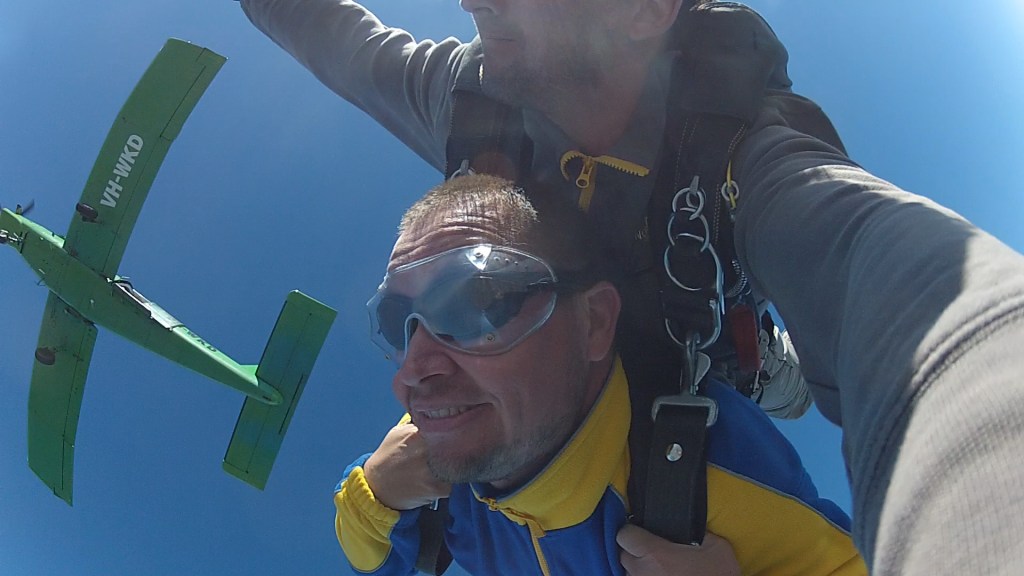
Disappointment. Now there’s a strange emotion to have in the middle of a skydive from 14,000 feet. The parachute opened, ending my freefall. I felt disappointment. It was a mixed emotion to be sure. I would have been more disappointed if it hadn’t opened.

The freefall had been an explosion of enjoyment for a full minute. I’d smiled for the Go-Pro, whooped for joy and as my cheeks were being blasted I looked skyward, drenched my face in the sun and quoted some lines from one of the most beautiful poems ever written, High Flight, by John Magee.

Oh! I have slipped the surly bonds of Earth…

I’ve topped the wind-swept heights with easy grace…

Up, up the long, delirious, burning blue…

Put out my hand, and touched the face of God…

In 1969, astronaut Michael Collins had a copy of this poem on the Apollo 11 mission and looking down on Earth had remarked that if Magee could write such a poem from the cockpit of a Spitfire, imagine what he would have written from a rocket ship in space.

John Macgee joined the Royal Air Force in June 1941, wrote High Flight in August and was killed in December. He was 19.

As I swung in my harness, linked in an embrace of clips and straps to my tandem partner Dan, I looked around. We were high enough that there was curvature to the horizon and I could see Penguin, Garden and Rottnest Islands just about as they appear on a map, from a top down view rather than from the view from shore.

The beautiful blue sky, the ‘delirious, burning, blue’ as Magee described it, contrasted lightly against the darker blue of Cockburn Sound, Shoalwater Bay, Safety Bay and the vastness of the Indian Ocean beyond.

Even the industry of Cockburn Sound looked spectacular. Silver networks of pipes, tanks and smokestacks with the black hulls of ships waiting offshore to come and collect whatever it is they’re refining, smelting and storing.

When I was a kid in the 1970’s, Cockburn Sound was a mess. I was lucky to spend school holidays by the sea. A little house in Shoalwater Bay was home to my family every school holidays and from the family runabout, the Red Witch, we would pull in King George whiting and revel in the silver flash in the water that would announce the arrival of the herring. I was also lucky enough to have a dinghy with a 1942 Seagull outboard engine which was responsible for disturbing the sleep of the local sea lion population for many years. We spent most of our time in Shoalwater Bay and Safety Bay because of the reputation Rockingham had for polluted waters.

The pollution of Cockburn Sound coupled with the rise of the bogun on land led to Rockingham developing a reputation it’s only recently shrugged off. Over the past few years, from a travel perspective, there has been a surge of interest in this area that has largely been bypassed by southern travellers for Mandurah and the communities further south.

At the beginning of 2015, Gemma Nisbet wrote in West Travel about Manuel Towers, a B&B in Shoalwater Bay. Gemma mentioned that it’s, ‘people from the city looking for a break that’s not far away’ who are coming to stay.   What a change has come over Rockingham! There have also been recent travel stories about Penguin Island, the local kayaking opportunities, swimming with dolphins, the new jetpack riding adventure and a beachfront promenade of dining opportunities that is hard to beat on the west coast.

Entering from above into this new world is Skydive Rockingham, an adventure tourism company that is catering to adrenalin junkies as old as 91 and as young as 12. On my jump, 13 year old Brandon-Lee had been presented that morning, as a surprise birthday present, the news that he was going skydiving. I would have loved to have got a wonderful quote from Brandon-Lee about how he felt about the experience but like you have to be when you’re a 13 year old boy, it’s all about actions not words. He didn’t say much but he can say he jumped out of an aeroplane.

Skydive Rockingham started dropping out of the sky over Rockingham in 2013 and have been frequent fallers above York (Skydive York) since 1996.

Arriving at the office on the foreshore at 0630 the level of staff enthusiasm was closely matched by the level of professionalism. While all the while smiling and asking how I was feeling, the paperwork was being checked and signed, scales confirmed I wasn’t lying about my declared weight and fitment of the harness and a firm introductory handshake with Dan were all accomplished without fuss.

“Do you have a nickname Dan? Diver Dan perhaps?”

“Nup. Just Dan.”

“Got it.”

After the short drive to Jandakot airport there’s no mucking about, we walk out to the aircraft which I’m told is an old crop duster from New Zealand. Less use of the word ‘old’ in the description of the plane would have been appreciated. Expecting to see an aircraft like Dusty in the movie ‘Planes’ I’m surprised to see something that looks more like a big green bean than an aeroplane. Never speak ill of a plane though, you don’t know what bigger plane it might be related to. Suffice to say, it was very narrow and I was already looking forward to getting out of it.

Dan, sitting behind me, starts clipping buckles and pulling straps and pushing me around like a hairdresser; tipping my head over to the side, pulling it up, pushing it down. As I feel him pulling straps I can’t help thinking of loads on my car or trailer that I always seem to loosen accidently as I try and tighten them.

I was about to ask him to shave the back of my neck when all of a sudden the two blokes in front of me just disappeared, they’d jumped out. Gone. No scream. No final questions to determine final agreement to embark at 9.8 metres per second per second towards the ground below.

Suddenly, unlike a hairdresser, Dan is pushing me towards the door. He reminds me to put my arms across my chest before exiting the aircraft. The funny thing is, I’m already outside the aircraft. He’s still inside with me stuck on the front of him.

Suddenly the plane isn’t there anymore.

Freefalling, or skydiving, only really became achievable once aircraft were able to operate at a high enough ceiling to allow time for falling before the deployment of the parachute. While jumping out of aircraft with parachutes and cloth buckets (not recommended) has been going on since not long after the Wright brothers first took to the skies, it wasn’t until the end of World War II that skydiving became a pursuit for adventure. Surplus aircraft and parachutes become available and ex-military parachutists wanted to do it for fun rather than being shot at as they descended.

As I’m falling, I’m doing what Dan has taught me, my arms are held out to keep my position stable. There’s not much else I have to do but enjoy the ride. I’m confident that Dan is checking his wrist mounted altimeter. I could tell him with a fair degree of certainty that we’re falling but I’m not aware at the time that our speed is closing quickly on 200 kilometres per hour. My car can’t do that.

After the parachute has deployed Dan grips my hand and tells me what a great job I’ve done. I’ll take praise most anywhere, most anytime but over the skies of Rockingham I found this a bit too difficult to take. Coming from the bloke who has literally shouldered the responsibility for our lives, it’s a great gesture to congratulate me but all I’ve done is grin my face until it hurt and quote the guts out of a 75 year old poem.

I’m given the opportunity to take the controls and I pull down hard on the right to begin our slow spiral towards the beach below. I focus on three dots below that I know are my family. I knew where they would be standing and I knew the colours of their clothing. With every second I drop closer to them. Dan snaps me to attention and reminds me to lift my legs up so that his feet touch down on the sand first. I stuff up. I don’t quite get my legs up high enough and as we hit the sand we end up looking like a sneaky couple seeking romance in the dunes.

As Dan unclips me from his harness our tethered relationship is at an end. As I leave his arms I am back in the arms of my family. I introduce them to Dan like he is God himself.

“Family, this is DAN.”

Next to the Skydive Rockingham office is the perfect venue to debrief the family, the well named, ‘Coffee by the Bay”. With fresh, warm muffins and a great coffee I regale the family and field their questions. The staff in the café have seen it all before. They’ve heard the descriptions and seen coffee cups go flying as gesticulating arms get out of control in the story telling moment.

Well I’m having my moment.

“So, kids, what did you think when you saw me coming in to land?”

chris-parry-0098